https://rss.com/podcasts/different-way-of-seeing/2597904
Lois 00:07
Hi, and welcome to the Accessible South Africa podcast. This is a podcast where we discuss travel in South Africa and beyond for persons with disabilities and special needs. I’m your host Lois Strachan. And now on with the show,
Lois 00:41
welcome to today’s episode of the Accessible South Africa travel podcast. I’m Lois Strachan. And today we’re going to be chatting to Bryony Chisholm. You know, every interview is special in its own way. And what I really enjoyed about chatting to Bryony was her sense of adventure, her approach to life, and the very practical approach that she takes when considering traveling to a new destination. And rather than me telling you about Bryony’s story, let’s dive straight into the interview and let Bryony speak for herself.
Lois 01:31
Good morning, Briony. Welcome to Accessible South Africa.
Briony 01:37
Good morning, thank you for having me.
Lois 01:38
It’s a pleasure, and great to have you with us. Let’s start off and, can you tell us a little bit about yourself?
Briony 01:45
Sure, I am 40-something. I had my accident when I was 21 on my way home from graduating as a pharmacist from Rhodes University in Grahamstown. So, it was, if there’s ever a perfect time to have that kind of accident, the perfect time. Because my life was going to change anyway. I didn’t expect it quite to change as it did, but I was ready for a change, which I think made the transition a little bit more easy. So I had my accident. I broke my neck, so I’m quadriplegic, which means I’ve got function of my arms and my wrists, but not of my fingers. I then went and completed my internship as a pharmacist, on the mine that I grew up on in Gauteng, and lived with my folks for a year. And then moved to Cape Town. And started working at the Division of Clinical Pharmacology at the University of Cape Town, as an information pharmacist at the medicines Information Centre. We opened the National HIV and TB Hotline 10 years ago and I’ve been working on that since. I’m currently only working part-time for them because I also do writing. I’ve published my first novel this year. And I’m also doing some post-grad study on HIV and TB. And my work at the Hotline actually put the itch back in my feet for travel. Because in 2016 I was asked to do trips all around rural South Africa, all seven provinces, excluding Gauteng and Western Province. And I was given basically free range to visit as many clinics as I could within a six-month time period, of being away for a week to 10 days a month for six months. And I plotted as back route as we could do in a normal car. And we travelled about 10,000 kilometres in that time, mostly on back roads and dust roads, visiting over 200 clinics. And that completely inspired me to explore South Africa again. We’ve always been travellers as a family. But South Africa is so beautiful and there’s so many parts of it that are worth visiting. So from there, I decided to slow down my work at the hotline itself. I do work for them from home. And I’m doing more travelling. And I blog about my travelling as well, not completely accessibility focused. My blogs are generally just a general travel story with something tapped onto the end that includes the accessibility of where I’ve visited.
Lois 04:47
So you’ve actually travelled quite extensively, both in terms of work and in your leisure?
Briony 04:54
Yes.
Lois 04:55
What challenges have you encountered while you’ve been travelling, and how have you overcome those challenges?
Briony 05:03
It was a very interesting expedition, if I can call it that, visiting the rural clinics. So basically we stayed at 60 different places around South Africa. And I’m talking very small town South Africa. So we stayed from hotels, to guest houses, to self-catering cottages, to a room in somebody’s house. And I researched as well as I could. Small town South Africa is still a little behind on being, kind of on the internet. So I was relying on just the few places that were listed on the internet. And then I was doing a lot of communication with people, saying, “I’m in a wheelchair. Is it accessible, to a point accessible?”. I travel with a friend who is very strong and very able. So a little step here or there is not a barrier to us, which it would be for some people. And I have both a urostomy and a colostomy, which actually makes things a lot easier, because bathrooms are then not such an issue. I can bath in a basin and don’t necessarily need a role in shower when I’m only staying in a place for one night. For those 60 places, they pretty much all said yes, we’re accessible. And probably maybe five at a push were truly accessible. But as I say, I was very open about it. And I was very flexible about it. And I said to people that one step isn’t a hassle. But what it did open my eyes to is that people just don’t know what accessible means. And it’s not from lack of compassion, or lack of trying. It’s just that they don’t actually know.
Lois 07:01
So, it sounds like the, part of what you’re saying is that there’s a lack of awareness that can impact on the ability for someone with a disability to travel.
Briony 07:15
Yes, yes, exactly. And, you know, every single one of them was perfectly happy to chat to me, and to discuss what they had and what they didn’t have. And to send me photos. So people are happy to help, they just don’t know how to do that. So it’s a lack of awareness. And I guess a reticence, because people don’t want to hurt your feelings. Or be, you know, not compassionate. So they’d rather just say no. Rather than finding themselves in a situation where they are uncomfortable, because they’re not sure how to deal with the situation.
Lois 07:55
Okay, what are some of your favourite stories from your travels?
Briony 08:02
I think probably my favourite story, now that it’s over, at the time it was not my favourite story, was our trip to Paris last year. I went to Sicily to see Eddie Vedder, because I’m a huge fan. And we tacked on two days in Paris, on our way back to London from Sicily. And I researched very carefully, found a metro station that we could reach from the airport easily, that was accessible. And then planned my AirBnB, according to that station. Only to arrive at the station and have to spend two and a half hours in the Paris metro, because the lift was being renovated. And we could not find any kind of official person. None of us spoke French. Everybody was busy, you know, just being Parisian and being busy. And we thought we might actually have to live in the metro for the rest of our lives. But luckily, well, I say luckily, it was just after one of the kind of terrorist threats, so there were a lot of soldiers around. And we eventually found four very beautiful French young soldiers who hoisted me up between them and carried me up three flights of stairs to get us out, and onto the streets of Paris. Which, as I say, at the time, it was really not funny. But now, now it is. Now, I think it’s one of my favourite travel stories. And for me, that’s what traveling is about. It’s about the stories that you make completely inadvertently. That was not a planned thing. In fact, it was very much unplanned,. But it makes a great travel story. And it was fabulous once it was done.
Lois 10:11
You are so right that it’s the experiences that we encounter when we travel that really make the richness of the diversity of our travels. So, Briony, what advice would you have for service providers who want to either check if their venues or activities are accessible, or who want to make them a little more accessible?
Briony 10:25
The main thing is to get people. I mean, this is why I love Accessible South Africa, because that’s what is the idea behind it, is to get people in who know. So, you know, asking an 13:architect who knows what the building specifications are versus asking somebody who is actually in a wheelchair to come to the place and to look. And to give, you know, just give practical advice on what can be there and what can’t be there, I think is the ideal. Obviously, it’s not possible always to do that. I think the second best option is to just be completely open and honest of what is there. So, put yourself in the shoes of somebody in a wheelchair, or somebody who can’t hear, somebody who can’t see, and look around your venue. Look for steps, look for obstacles. You know, if you actually put your mind to it, even if you’re not in a wheelchair, you can actually see the barriers. It’s just a matter of thinking a little bit and working it out. Or getting somebody in who knows what it’s like. And also to just be open and honest To people, and say,, look, if you’re not sure, just say, look, we’re not sure, you’re very welcome to come and we will help you with anything that does become a barrier. And lots of photos. The most invaluable thing that I’ve found with any place that I’ve visited is being able to see what I’m going to get on the other side. Because I can then decide if that’s something that I can deal with or can’t deal with. And that includes pathways to places, entrances, width between the bed and the wall, you know, simple kind of practical things. To be able to see that is wonderful. That’s one of the reasons I love Google Earth as well. Because you can actually go in and see is the Airbnb that I’m wanting to go to, or the hotel that I’m wanting to go to, is it on top of a hill, which will make it impossible for me to actually get out and sight see? There’s a lot to be said for knowing what you’re going to.
Lois 12:49
I think that leads quite nicely into a follow-up question, which is about the technology that you use when you travel and when you’re planning your travels, the types of apps and other technology that you find assists you to make that type of decision. So what can you tell us about that?
Briony 13:07
The internet is a fantastic thing, and I don’t know how anyone actually managed to do anything before the internet. I’m a bit of a Philistine when it comes to apps and things like that. So the majority of my research is done online. As I said, Google Earth is fantastic. And then I find most of the kind of accommodation sites and places like that, the Airbnb site as well. They’re trying very hard to make things easier from an accessibility point of view. But they’re not managing particularly well. Airbnb have recently redone their format, but if you click two of the things that you may need from an accessible point of view, you basically exclude every place. So you then can’t find places. And a lot of the booking.coms and those kind of places, you just tick an accessibility box and it doesn’t really mean anything. So my research is initially done on sites like that. And then it is done through email and through WhatsApp, where I actually speak to the people at the place and say, “This is what I need, what do you have there? Please send me pictures.”
Lois 14:33
For those of our listeners who aren’t familiar with services like Airbnb. Can you just give us a little more detail of exactly what you mean by saying “If you pick two criteria, it might exclude all the places. So what are we actually talking there?
Briony 14:51
So Airbnb has filters. The same as you can filter if you want two bedrooms and one bathroom, or completely separate or living with a host. They’ve got a set of filters to do with accessibility. And they include ramp free access, lifts in the building, universally accessible bathroom. So there’s a whole long list of them. But if you filter with just one or two, it filters out places that have not ticked all those boxes. And I think again that’s where it falls on the provider, so the Airbnb host. They need to, they now, presumably as soon as they click any kind of accessible thing, they have to either click yes or no to all of the requirements for it to be universally accessible. And while universally accessible is fabulous and is ideal, places that have already been built are more often than not not completely universally accessible. And that is not a problem for some people, and it is for others, depending on their levels of disability. But a kind of automatic filter like that. So if I click ramp free access and the host does not say that they’ve got ramp free access, even if they do, it will exclude that place. And again, I think people are reticent, hosts are reticent to say, “Yes, we are accessible,” because they’re not sure what exactly that means. And again, there’s the kind of space for something like Accessible South Africa, where you’re getting people to meet up with the host and say, “Okay, this is what you need, and this is what you don’t need. And this is what you need to say”.. You don’t necessarily have to be completely universally accessible. But you need to take pictures of this, this, and this. And you need to say, “This is what we have, and this is what we don’t have. But we are willing to help you. Or we’re not willing to help you.” Which, you know, whichever way, it’s completely up to the host. But I think it is really useful to have people who know what they’re looking for, or what is needed to help that kind of huge gap between hosts having any knowledge at all and having none and being too nervous to actually list.
Lois 17:30
Briony, you’ve already shared one really interesting experience with us, in the metro in Paris. What other humorous stories do you have from your travel experiences, and perhaps here in Cape Town or somewhere in South Africa?
Briony 17:47
Yeah, I was just about to say I also had a fantastic experience at Muizenberg Station. Where, again, I absolutely adore going on the train. And the Cape Town Metro rail is, let’s say, not hugely accessible. Some of their stations are accessible, some of them aren’t. It’s very difficult to get out of Metro Rail which ones are, which ones aren’t.. So we decided on a beautiful, in fact it was probably a year ago, because it was a beautiful spring day, to catch the train from Kenilworth Station to Muizenberg and go and check out the beach. Which we did and I got off the train in Muizenberg on the sea side of the station, where there is actually a ramp that goes down to a gate which was firmly locked. And of course nobody knew where the key was, or who had the key. But it being South Africa, of course there were loads of people around who were perfectly willing to help to get me down. I think there are about five or six stairs that go down onto the beach side of the station. However at the bottom of those stairs was parked an enormous Merc, directly across the entrance. Meaning that once I’d got down the stairs I couldn’t actually get out of the station. Which, again in true South African style, was not a problem for the four complete strangers who had helped me, to lift me up in my wheelchair over the bonnet of the Mercedes. And set me free onto the beach.
Lois 19:26
I have experience of traveling on Metro Rail. I used to catch trains to work from lakeside, through Muizenberg, and all the way down into Simon’s town. So it’s a very well known train station to me. So, I can see that happening. You must be a very courageous woman to keep up with travel despite that type of experience.
Briony 19:54
Yeah, I don’t know if it’s courageous or slightly silly, to be honest. But, the thing is that the bits in between, the difficult bits, are such a tiny part of it. And I think anyone who’s traveling, whether they’re in a wheelchair or not, there are difficult bits to traveling. There are some bits of traveling that are not fun. But the rest, the adventure, and the meeting people, and the seeing places, and the discovering stories, and, you know, make up for it hugely. So it kind of becomes a little side issue, where you have the problems. And they eventually do just become part of fabulous travel stories. And I mean, I think that is one of the things that, people who love travel are possibly a little bit more adventurous and a little bit, need to have a little bit more patience, and need to know that everything, you can plan until you’re blue in the face. And sometimes things just don’t go according to plan. And you’ve just got to, you’ve just got to roll with it. Without that attitude nobody’s ever going to travel, you know, regardless of whether they’re able-bodied or not.
Lois 21:14
So what message would you like to give to people with disabilities who are perhaps keen to travel, but are a little nervous of doing so? What message could you give them to encourage them to do so?
Briony 21:27
The main thing is to just do your research. The better planned your trip, the less likely it is that there are going to be hassles like that.. You know, there are still always going to be little blips. But if you really plan well, and by that, certainly from my point of view in a wheelchair, that really does mean planning right up to the tiny details of where the guest house that I’m staying in, is it on top of a hill? You know, like minute details like that. Is it on top of a hill? Is it close to some transport that I can actually use? Where does that transport go? Does it go to the places that I want to see and I want to go to? So it’s a lot of planning. But I think that the planning will make the trip a lot easier. Also I think reading, reading people’s personal experiences. And I’m going to kind of self promote terribly, but you know things like my blogs where you can actually read, “I went to McGregor, and I did this. And in McGregor town, the main road is relatively flat, and there are restaurants that you can get into.” You know, that kind of thing. I think reading people’s personal stories really opens up a new world and makes traveling a little bit less scary. And, you know, lots of people are nervous to travel. And, if you are nervous to travel, there are lots of places that you can go as a group, or guided. And I think that’s the way to go. If you want to explore but you’re a little bit nervous, then go on a guided tour, have somebody show you around, have somebody else deal with the minutiae of travelling, and you just enjoy it. But don’t, don’t let nerves stop you from exploring.
Lois 23:23
Well at that point, maybe I should ask you where can people find out more about you and your blog?
Briony 23:29
Well, I am on, I’m on Facebook as Briony Chisholm, my name. And I have a blog which is called Navel Gazing 101, which is a WordPress blog, I think. If you just, if you just google search navel gazing 101 it’ll come up. And I am on Instagram as Briony etc. B R I O N Y E T C. And I do also have a Twitter account, but I am terrible at Twitter so there’s no point in trying to find me there.
Lois 24:05:
I think nowadays there are so many different platforms that are available, that sometimes we have to choose, and focus on the ones that work for us.
Briony 24:15
Yes. I, just from a time point of view, and yeah. So, Twitter I’m not good at it.
Lois 24:21
That’s okay, we can forgive you for that. We can’t all be good at, great at everything, you know.
Briony 24:28
Yeah. And the other thing is that my, many of my blogs and certainly the accessibility focus ones, are also, will be on the Accessible South Africa website as well. So, and they link, I think, to my blog. So I can be found there too. And, in fact, you know for somebody who’s looking for purely accessible stuff, the Accessible South Africa site is the way to go. Because that has the personal experiences, and it has the lists of people who offer accommodation and activities etc.
Lois 24:59
Great so you can also be found on accessiblesouthafrica.co.za?
Briony 25:03
Yeah my blogs are copied from mine to there.
Lois 25:07
Great. Well, that’s good to know as well, because we do point people into the website through the podcast here as well. As a final question, any future travel plans? What are the sorts of places that you would love to go to but haven’t yet had a chance to visit?
Briony 25:26
Oh, how long do you have? I think my next kind of overseas trip well we’re starting to contemplate a little road, well a long road trip across America. Not now, preferably when Trump is gone. Two friends of mine are turning 50, so we’re planning possibly for the three of us to spend six months to a year traveling across America, small town America, seeing all the biggest doughnuts and the biggest whatever other things that they have. From a South African point of view we are heading to the Eastern Cape, which holds my heart very dearly, at the end of October For ten days, where I’m doing a couple of book launches of my novel. But we will also be doing, kind of road tripping that, so we’ll be staying at different places, and experiencing different places. So yeah, that’s all for now. I’m also studying, so I have to come back and write exams. I mean, kind of settle down and get some studying done.
Lois 26:39
Both of those sound like exciting trips that are in the planning stage. So, we wish you success with those. And just very quickly, I know it’s not travel-related, well it might be travel-related, but a quick punt for your book. Tell us about it.
Briony 26:54
It is a very fluffy chick lit book about a 30 something year old woman living in Cape Town. So, and it’s her experiences of dating in Cape Town, and delving into internet dating. And basically her adventures at, deciding that she’s no longer going to look for a relationship, she’s going to do a stint of one night only, kind of, encounters. And how that turns out.
Lois 27:29
And what is it called? And where can people find it?
Briony 27:32
It’s called one Night Only. It is on Amazon. But if anybody living in South Africa, it’s expensive to get it through Amazon, and I have some hard copies at home that I can sell to them directly. And it’s going to be in some bookshops, but in Johannesburg, not here yet. We are still marketing it and getting it out there. But in the meantime I have copies for sale.
Lois 27:56
Great. Briony, thanks so much for sharing some of your experiences of travel, of your travel blog, and your new novel that’s just come out. We really appreciate the time you’ve spent with us. We wish you success with your travels, and thank you for sharing your experiences with us on the Accessible South Africa podcast.
Briony 28:14
Thank you very much for having me, it was lovely.
Lois 28:36
That’s it for this time. You can find out more about us on the web at www.accessiblesouthafrica.co.za, on Facebook @Accessible South Africa, or on Twitter @AccessibleSA. You can also email us on podcast@accessiblesouthafrica.co.za. Editing was done by Deirdre Gower, and our theme music was by Lui Chee Chau, based on a motif by Lois Strachan. Thanks for listening. We’ll see you next time.
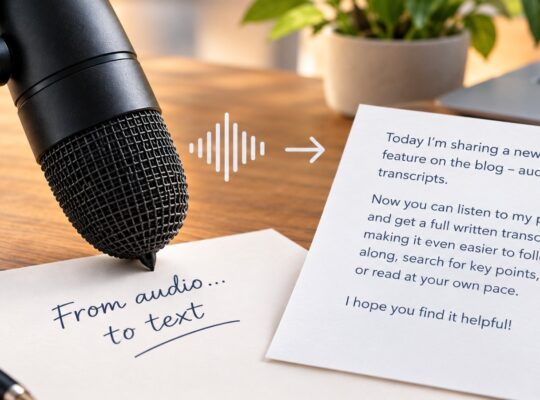
This transcription was created by AI using AIKO and was edited by Lois Strachan. Please note some contact details and apps may have changed or no longr be available.